What began in 2024 with the first GenAI boot camps has, within two years, evolved into the Wertgarantie Group’s own AI infrastructure. With WGG GPT, new customer-facing applications, and a venture-clienting approach, the insurer now combines its own technological expertise with solutions from the startup ecosystem. This case study highlights the key decisions made along the path from experimentation to operational use and explains how formats, professional exchange, and startup contacts from the InsurLab ecosystem supported this development.
In the spring of 2024, the Wertgarantie Group did not yet have a strategy in place for a company-wide AI infrastructure. The initial focus was on understanding what generative AI could accomplish in day-to-day work. Employees from various departments participated in InsurLab Germany’s GenAI boot camps, where they gained hands-on experience with language models. This initial step quickly evolved into more than just a test phase within the company. Colleagues took up the topic, contributed their own ideas, and tested applications for knowledge research, text support, and the analysis of complex information. Wertgarantie deliberately adopted an exploratory approach that gave employees the space to gain experience and identify relevant real-world use cases.
Two years later, the picture has changed significantly. With WGG GPT, the insurer—which specializes in equipment protection—operates its own AI environment. Generative AI is increasingly being integrated with data sources and operational processes; new applications are emerging in customer service; and, at the same time, the company is collaborating with several specialized startups. What is interesting about this development is not so much the number of individual use cases as the sequence behind them: what began as initial experimentation gradually evolved into technical and organizational decisions. The boot camps, other specialized programs, and the collaboration with startups from InsurLab Germany’s Collaborator Program were integral parts of this journey at various stages.
Our Own Answer to the Platform Question
Experimentation with freely available AI services quickly reached its limits. For an insurer, data protection, regulatory requirements, and control over corporate data play a different role than they do in the private use of a chatbot. Wertgarantie therefore decided to pursue its own technical approach. WGG GPT is based on the open OpenWebUI interface and can integrate various language models, including proprietary models via interfaces such as those from OpenAI. Some of the technical components were further developed in-house. The architecture is complemented by workflow automation—including n8n—so that AI functions can be integrated directly into existing processes.

Fynn Wolken (Manager of Digital Innovation at WERTGARANTIE Group)
The decision touches on a fundamental question that many insurers are now grappling with: How much in-house infrastructure and expertise does a company need when models and providers change at rapid intervals? Wertgarantie has opted for openness rather than tying itself to a single provider and, according to the company, has built a high-performance environment with relatively low investment. The InsurLab ecosystem provides an indication of the transferability of this approach: another insurer in the network has since implemented the open-source approach chosen by Wertgarantie within its own organization.
“With the open-source approach, we wanted to remain flexible and be able to integrate different models. Precisely because technology is evolving so rapidly, this openness is important to us.” Fynn Wolken, Digital Innovation Manager, Wertgarantie Group
During an early testing phase, WGG GPT was already extensively tested throughout the company. More than 80 employees from various departments participated, using the platform for knowledge management, data analysis, and operational tasks, and providing feedback that led to new requirements. This gave the skills-building process a different quality than that of traditional training. Employees not only learned about the basic functions that generative AI offers, but also had to assess, within the context of their own work, when the results are helpful, where oversight remains necessary, and for which tasks its use is actually worthwhile.
The more challenging part begins after the pilot
Over time, the focus shifted. Internal access to language models was already available; the new challenge was to integrate AI into existing systems and processes. In customer communications, Wertgarantie now uses a workflow that processes customer feedback in a structured manner and generates suggested responses, which employees then review and use to determine the final reply. In addition, the company is testing speech-to-speech technologies for new forms of customer interaction.
The WERTbot is also an application that can be accessed from outside the company. The AI-powered assistant is designed to provide support for device issues, suggest possible steps to take, and identify suitable repair options within the Wertgarantie ecosystem. In doing so, it aligns with the company’s sustainability approach of „Repair Instead of Throwing Away.“ The WERTbot was recently in the testing phase and is expected to be available to end customers for the first time soon at https://www.reparieren-statt-wegwerfen.de/

Chiara Orrù (Product Innovation & Development Manager at WERTGARANTIE Group)
It is precisely these examples that illustrate why scaling up requires more than just a compelling prototype. As soon as AI is integrated into existing processes or used in customer communications, responsibilities, data access, quality requirements, and regulatory guidelines must evolve accordingly. To address this, Wertgarantie has established the WERTlab, which combines innovation, process development, and governance. Business units contribute requirements and ideas, while the technical implementation of productive solutions is prepared in collaboration with application development. In addition, the Business Intelligence Competency Center handles traditional analyses and analytical models, such as those related to customer churn.
“As the number of ideas grew, we needed a framework that would bring together subject matter expertise, technical implementation, and governance. That’s exactly the role the WERTlab plays for us.” Chiara Orrù, Product Innovation Manager, Wertgarantie Group
At the same time, the process for addressing regulatory requirements was systematized. Wertgarantie follows a “compliance-by-design” approach: data protection, information security, and regulatory requirements are integrated into the development process at an early stage, rather than being reviewed only after the fact. The EU AI Act plays a central role in this regard.
Combining In-House Expertise with External Solutions
Another decision concerns collaboration with startups. Wertgarantie is building its own technical expertise while also selectively leveraging solutions from the market. To this end, the company is collaborating with several startups from InsurLab Germany’s Collaborator Program, including ConforaLabs for testing AI models against regulatory requirements, Vaarhaft and INCA for AI-powered fraud detection, Experial for new forms of digital customer panels, and Deepslate as a provider of speech-to-speech AI models.
This is based on a venture-clienting approach: solutions are tested early on in a real-world business context. If the testing phase is successful, they can be rolled out company-wide. In this way, Wertgarantie combines two approaches that are often viewed separately within companies: building in-house capabilities and collaborating with external innovation partners. In-house expertise helps the company better evaluate and integrate new technologies. Startups bring specialization and development speed to areas that do not need to be fully covered internally.
The exchange within the InsurLab ecosystem—through boot camps, masterclasses, Topic Days, and insureNXT—played a key role in identifying new technologies early on, sharing experiences, and learning from one another. Implementation remained the responsibility of the company: Wertgarantie itself decided how to translate these ideas into architecture, applications, the WERTlab, or specific startup partnerships.
Three Principles of a Pragmatic AI Transformation
According to Wertgarantie, the experiences of the past two years can be summarized in three principles:
First: Open source instead of platform dependency: The deliberately chosen open-source approach enables technological independence, data sovereignty, and comparatively low operating costs.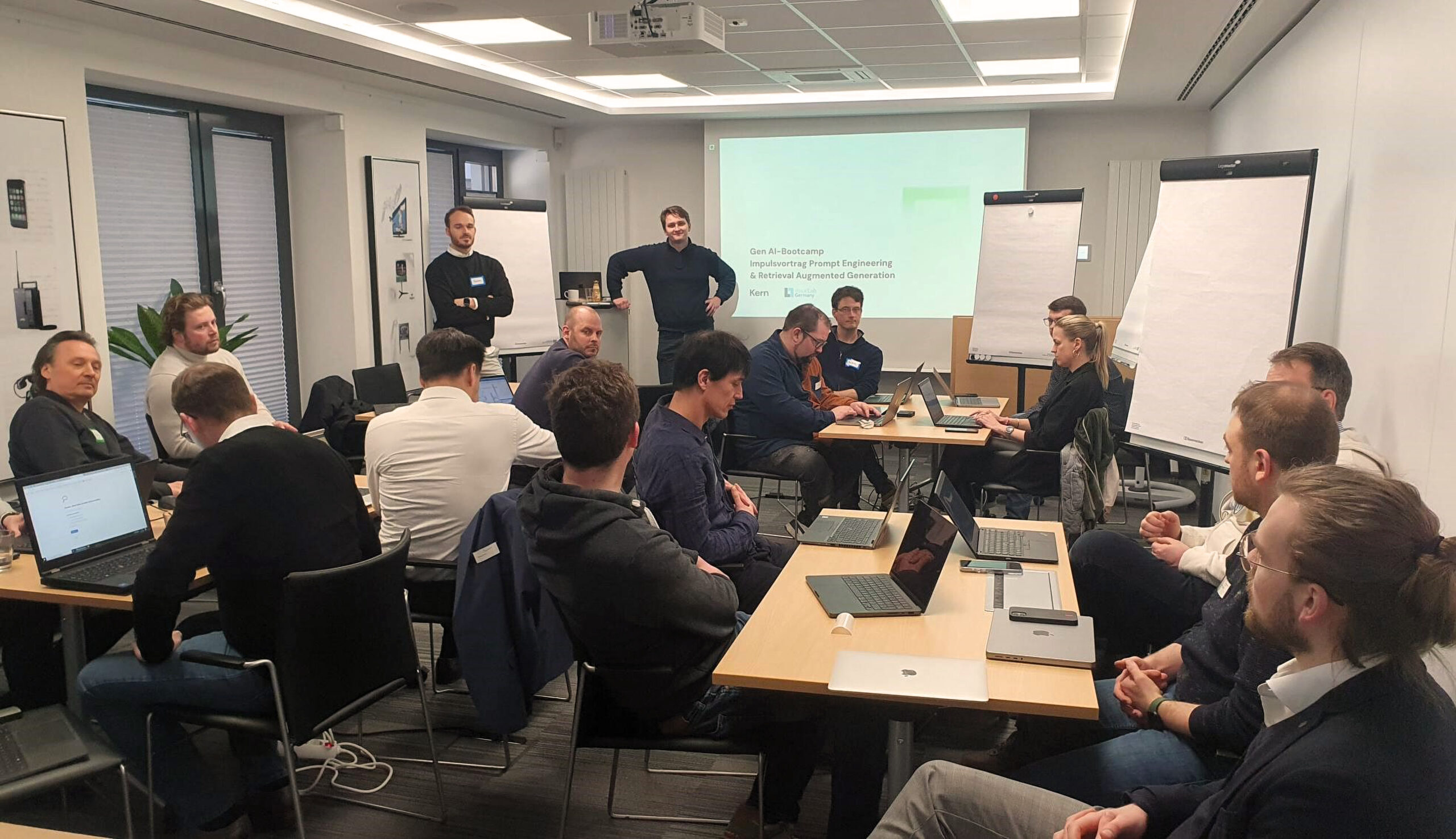
Second: In-house development combined with venture clienting: The company’s own development capabilities are strategically linked with partnerships with startups to quickly test innovations while simultaneously building internal expertise.
Third: Innovation within the ecosystem: Many ideas emerge from exchanges with insurers, technology partners, and startups, particularly within the InsurLab Germany community.
A journey that is not yet over
The current status after two years is more interesting than a completed success story. Wertgarantie has moved beyond the purely experimental phase but continues to work on integration and scaling. The architecture continues to evolve, new applications are being tested, and as operational use grows, so do the demands on governance and organization. This is precisely where the difference lies compared to the spring of 2024.
For other insurers, the key takeaway lies less in replicating WGG GPT or individual applications and more in the sequence of questions. It all began with a practical understanding of the technology. Next, the company had to establish its own technical and regulatory frameworks. As usage grew, processes, governance, and clear lines of responsibility were added. External partners were brought in where they could provide additional capabilities and speed—not as a substitute for the company’s own decisions.
Generative AI is therefore no longer just a testing ground at the Wertgarantie Group. It is increasingly becoming an integral part of the company’s digital infrastructure and an organizational capability that the company is continuing to expand.

 German
  English